Tampilkan postingan dengan label Study. Tampilkan semua postingan

Warranty Direct Reveals UK’s Least Reliable Engines, 3 German Brands Among the Worst

Diposting oleh Unknown on Selasa, 22 Januari 2013


Cars are complicated machines made out of thousands of parts that, even when their owners take great care of them and follow the user and service manuals religiously, sometimes go wrong. After all, that’s what warranties are for.

Of course, warranties at some point expire, and while a light bulb or something equally minor may be of little concern, the engine is a completely different, much more scary and costly issue.
Read more »
Read More

Carscoop's 10 Most Viewed Stories of 2012

Diposting oleh Unknown on Selasa, 01 Januari 2013


No doubt, it's been an interesting year in automotive news. Besides an abundance of important new model presentations such as the VW Golf Mk7, we also witnessed the rebound of North American sales, the rapid decline of Europe's auto market amidst the euro currency crisis, and even announcements on the re-birth of brands like Datsun, just to mention a few of the things that took place in 2012.
Read more »
Read More

The Top 10 Cars Most Likely to be Targeted by Thieves in Britain

Diposting oleh Unknown on Jumat, 28 Desember 2012


General insurance company Swiftcover has released a list with the top 10 vehicles that are most likely to be stolen in Britain.

The company states it analyzed more than 2,300 theft claims among the UK vehicles it insured from February 2011 to February 2012, while taking into account the estimated numbers of cars on the road and removing models with less than ten cases of theft per year.
Read more »
Read More

Electric Vehicles Save Money, Can Also Pollute Like Gas Cars: Study

Diposting oleh Unknown on Kamis, 19 April 2012


Gasoline-powered cars are slowly starting to look like pirates plundering the world for fuel and slashing environmental throats as they go. Thanks to that, the fair maiden electric vehicles with zero-emissions claims and low-cost fueling can easily float in on the smog cloud looking squeaky-clean. But are they?

A new study by the Union of Concerned Scientists (UCS) sheds light on the carbon footprint, or lack thereof, that electric vehicles have. The 60-page document goes in-depth to reveal pollution produced by recharging cars like the Nissan Leaf and the differences in cost to refuel an average gasoline-powered compact car versus charging a pure EV.

It’s true that driving an EV will almost certainly save drivers money “at the pump:” The study shows that drivers save up to $1,200 dollars annually by driving a Nissan Leaf. It also makes some basic assumptions to justify those numbers: first, that compact cars get an average of 27 mpg, second that efficient hybrids get 50 mpg, based on EPA ratings and third, gas costs $3.50 per-gallon. Those standardizations allow for the aforementioned comparison and cost savings statement.

Saving money is great, but the study isn’t solely concerned with annual fuel cost of ownership. A large portion of the UCS’ report discusses the carbon footprint produced by EVs, something people willing to suffer through range anxiety and planned charging sessions are almost invariably conscious of.

It turns out that EVs save money across the board, but can also create more greenhouse gas emissions than a traditional gas-burning car. How can this be possible?

We spoke to Don Anair, the study’s author, and he said 45 percent of the U.S. population lives under a power grid clean enough to best a Toyota Prius’ 50 mpg rating. In other words, for more than half of Americans, it’s actually less harmful to drive a Prius ($24,000 to start), which is more than $10,000 cheaper than a Nissan Leaf. Believe it or not, there are actually parts of the country where sub-compact cars are easier on emissions than an EV, here’s why.

American power plant processes aren’t uniform, and the power produced within create varying levels of greenhouse gas emissions. A table in the UCS document actually shows that less than a third of American electricity grid regions generate enough green energy to best the Toyota Prius’ 50 mpg average economy.

The study boils down to two things: cost to drive and cost to the environment. It demonstrates that they are two entirely different issues and that buying an EV doesn’t necessarily save the environment. In fact, on the country’s “dirtiest” energy grid it’s actually less harmful to drive a 2012 Volkswagen Passat TDI than a Nissan Leaf.

Anair did also point out that only 18 percent of the population lives in an area where coal-generated electricity is prominent enough to make EVs less efficient than a sub-compact.
Read More

Families Spending More on Transportation Than Food: Study

Diposting oleh Unknown on Jumat, 13 April 2012

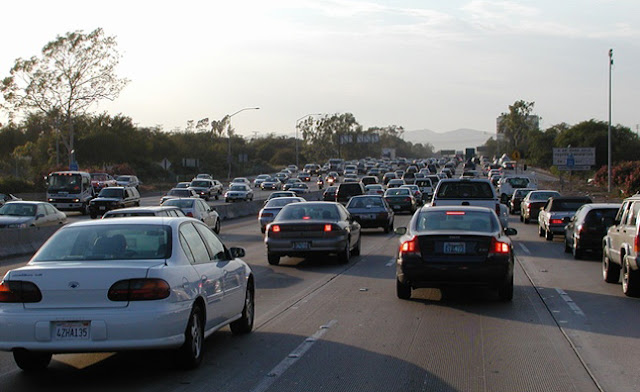
Traffic-congestion

According to a recent government study, the average American family now spends more a year on transportation than food. While higher gas prices are a significant factor, the study also says a big part of the problem lies with traffic congestion (which wastes a whopping $1.9 billion per year).

Furthermore, a lack of adequate public transportation in many areas and a crumbling infrastructure of roads, bridges and tunnels is making the situation worse.

Given that many municipalities have seen their budgets cut in recent years and with the cost of new construction projects and public transportation initiatives, plus a current lack of enthusiasm among voters for supporting them (raising taxes to fund such projects is essentially the only choice), it is unlikely we’ll see any improvements to the situation soon.

That said, there are a number of things motorists can do to try to ease the burden. Driving smoothly (i.e. making a gradual transition from acceleration to braking), is one aspect. Another is making sure your vehicle is in tip top condition (i.e regular maintenance is performed and correct tire pressures are checked and maintained frequently). Avoiding non essential trips and carpooling to work are others, while investing in a portable satellite navigation system can help motorists avoid potential traffic black spots.

A further option is moving closer to work, or working from home more often to reduce the need for driving. In fact, the study says that those who were able to live in “location efficient” housing, were able to save $200 per month. However, even in the 21st century, such options aren’t always open to all of us.
Read More

New Study Shows that New U.S. Market Vehicle's Fuel Economy Improved by 14 Percent from 2008-2012MY

Diposting oleh Unknown on Rabu, 08 Februari 2012


A new study by the University of Michigan Transport Research Institute shows that car manufacturers have managed to improve their new cars’ fuel economy by 3 mpg in the last four years.

According to the study, the average fuel economy of all 2012MY light vehicles available on the U.S. market is 21.5 mpg US (10.9lt/100km). That's a far cry from the 54.5 mpg US (4.3lt/100km) target set for 2025, but still an impressive 14 percent up or +3.0mpg from 2008MY’s average of 18.9 mpg US (12.5lt/100km).
Full article: http://carscoop.blogspot.com/2012/02/study-shows-that-new-vehicle-fuel.html
Read More

Report: New car leasing rises to 20 percent of U.S. sales in 2011

Diposting oleh Unknown on Senin, 06 Februari 2012


New light-vehicle leasing increased in 2011 from a year earlier, to 20 percent of U.S. retail sales, according to the Manheim 2012 Used Car Market Report.

The report notes that “for the most part”, the new car industry had the right approach towards leasing. This constitutes of leasing new cars to buyers with good credit who like to regularly change their vehicles, as well as projecting realistic end-of-lease resale values.

Overall leases rose 17 percent over 2010 to 2.1 million units last year and a startling 85 percent more than 2009’s 1.14 units, when buyers were deterred by the recession.

The report also notes that because fewer vehicles were leased during the recession, off-lease volumes will continue to decline this year. That decline is expected to contribute to tight supplies of fairly new, low-mileage used vehicles, which in turn should bolster used-vehicle prices.

Preliminary data show that the number of vehicles sold at National Auto Auction Association member auctions in 2011 declined 8 percent to less than 7.8 million units, the fourth straight year of declines, the report says.

Sales of vehicles that are off-lease, retired from rental fleets or owned by other commercial sellers sold at NAAA auctions fell “more than 20 percent” in 2011, while sales of dealer-owned vehicles increased 10 percent.

Dealer-owned vehicles made up 55 percent of all vehicles sold at NAAA auctions in 2011, up from 45 percent in 2010 and 40 percent in 2009.

Story References: Autonews

Read More